
oral histories
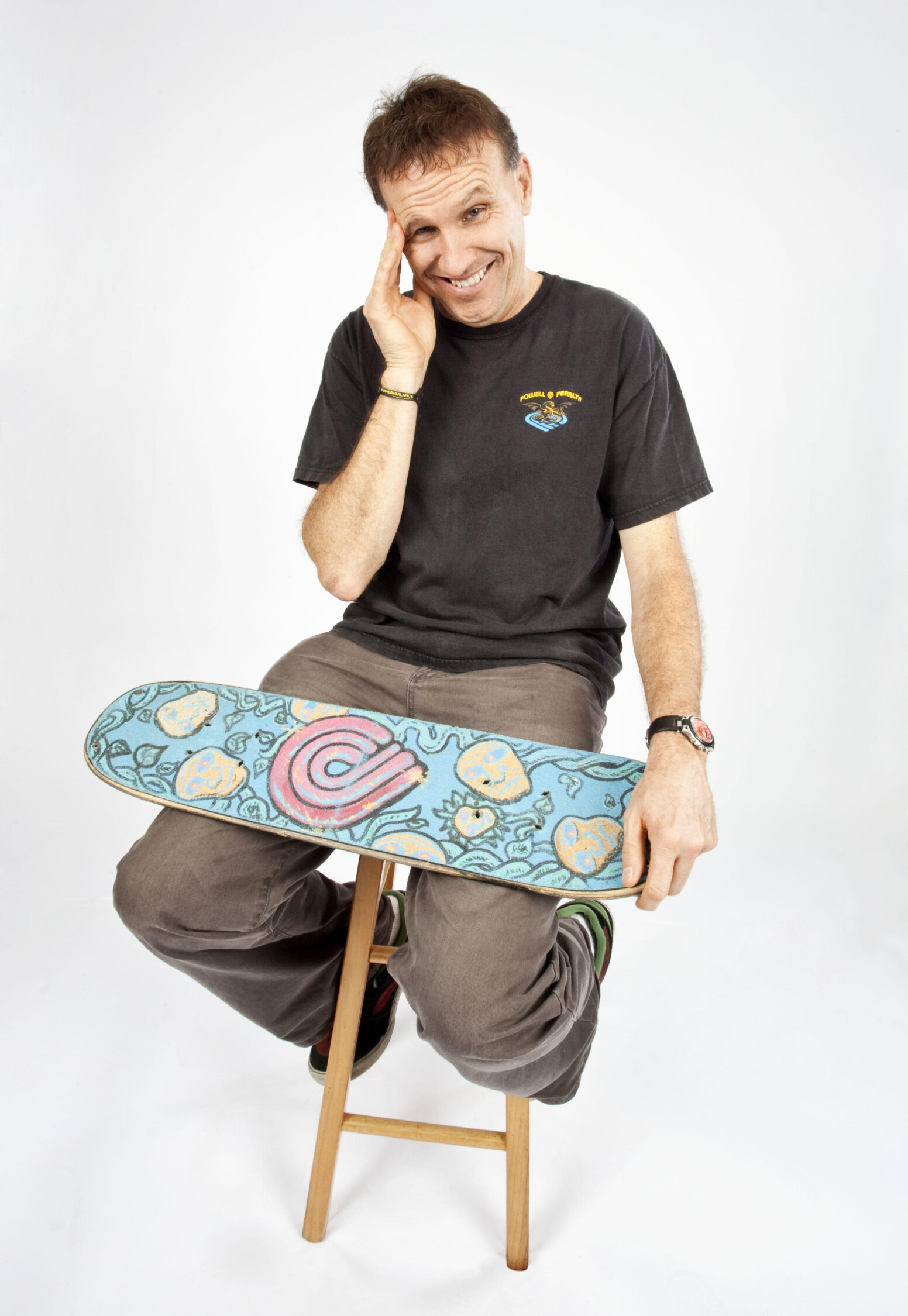
Kevin Harris
My backyard created such good humans.
Richmond native Kevin Harris turned pro in 1982, becoming Canada's first professional skateboarder and is still rated as one of the top freestylers in the world.
He started Ultimate Distribution, Canada's first and largest skateboard distribution company, Canada'a first skateboard magazine, Concrete Powder Magazine, the legendary Richmond Skate Ranch--which helped launch several of Canada's top pros--and co-owned the famous RDS Indoor Skatepark. A member of the Ripping Squad and the world famous Bones Brigade skateboard teams, Kevin is known for his fluid skating style, incorporating complex variations with exceptional foot work.
Kevin helped start and promote the highly successful "Slam City Jam" which put Vancouver on the map as a mecca for skateboarders. With Kevin's success in both skateboarding and the business world, he once again brought his knowledge to the table as one of the owners of the World Freestyle Round-Up.
Tell me about your family and what it was like to grow up in Richmond during the ‘60s.
It’s totally different than how kids get raised today. It was basically like “go do your thing, as long as you’re home before the streetlights come on” and “come home for dinner” but other than that… It was like—I grew up on a street that had numerous kids my same age. If we were playing soccer, we were all playing soccer. If we were playing baseball, we were all playing baseball. We always did something daily, and again, before cellphones. So, it was picking up the phone and saying “hey, let’s meet at this guy’s house and do that.” When skateboarding hit in 1975 that’s what changed all of our lives and everybody—because it was looked upon by them as, kind of, a fad coming in—and all my friends went from having whatever we were doing at the time—we had dirt bikes and everything because Richmond was all farmland so we could go out in the back yards and to back fields and ride dirt bikes—and then skateboarding hit and everybody just got a skateboard. So, a very unique time. When I look back thinking, I think a lot of teenage kids have the same thing, because all [of them]—unlike nowadays we were out playing road hockey together. There were a lot of things, daily, going on. Raining, snowing, it didn’t matter. We were always together, just a bunch of kids on the street.
And what was the street like? Was it rural? Was it more…?
It was your typical sixties thing where they were starting to build up Richmond, where everybody kind of had a half-acre, a quarter-acre, [and] were building homes. All the houses on the street, you know, were fairly new built, probably in the ‘50s and ‘60s. Then by the time I was in the ‘70s, all the families who had moved in the ‘60s all had kids roughly my same age. So…
You had a fairly big back yard?
A big back yard, which was lucky, that’s why that ramp went in. But, you know, let’s just call it on twenty houses, thirty houses around my neighbourhood on Maple street: over half of them had kids. It was always something, and we were very close. Like my neighbours had kids and so on, so to do something for the day was easy because there were so many kids around.
And you mentioned everything changed in 1975. What happened in 1975?
I was very athletic and did all the sports, and loved all the stuff that I did, and active. Then something about skateboarding, when I witnessed it for the first time, completely changed my life. Everything revolved around that. So even when I went to school, art class was making skateboard stuff, making clay skateboard parks, and writing stories, always about skateboarding. I think I learned a lot from that time, because through the ‘70s it was still looked upon as something you did not want your kids to do. Now I look back going “what my mom and dad would have went through” because it was looked upon by the society as “don’t let your kids skateboard” for whatever reason it was.
How did you get acquainted with skateboarding, given that it was so counterculture?
I always said that “things happen for a reason and thank goodness they happen.” But there was an article in the paper that my mom read, the Richmond Review, that was saying there was a skateboard demo team from California coming to the Richmond Dairy Queen. And I didn’t think too much of it, like it was the yo-yo guy coming to your school—it wasn’t a big thing. It wasn’t like I was like “let’s go!” My mom was like “oh you know, we should go check that out” and I was like “yeah, sure, whatever.” And so, my mom brought me, and thank goodness that she brought me and my friends, because now I’m watching a culture coming out of California that I was just completely blown away with. I think some of the things that really stuck out in my mind was what we call a “wedge ramp”: a 45-degree angle ramp. I could not believe that somebody pushed, went up on a skateboard, turned, and came back down a bank, and I was just like, blown away. And there was another guy there, named—nicknamed Doug Saladino [nicknamed the Pineapple], who was one of the best in the world at the time. He did what was called the “pineapple flip” where he rolled along and the board flipped under his feet, and he landed back on it. For something like that – it was just game changing for me. I want to do what these people are doing. So, you instantly get into it, right? You find every piece of information about it you possibly can, and again, [it’s] before YouTube and the Internet, so you try to find skateboard magazines. “Where do you find a skateboard?”
You’re just trying to go through anything to get a skateboard and get into this.
And was there a wealth of opportunity in Vancouver—the Greater Vancouver area?
No, at that time it was, it was so new to Canada, and there was no skateboard parks of course. There were areas that [were] instantly found out—within a week that skateboarders were going to—and it was as simple as a bank wall. It wasn’t a skateboard park, but it was something that you could go up to, and there was only maybe one or two “spots” in Vancouver—we call them “spots”—that were skateboard-oriented. Did the general population want us there? Absolutely not. It wasn’t a true skateboard park, but it was someplace you could ride. Because we were looking at magazines going, “these guys in California ride in empty swimming pools! How do we find that thing to ride?” And they went through a drought, that’s why they had empty swimming pools in 1975 in California. We weren’t going through that, right. You couldn’t find an empty swimming pool. But a couple times when they came in, I can’t even remember how it got around because there were no cell phones, but instantly a hundred skaters would show up to the empty swimming pool. And you might have two hours to skate before the people got home and kicked you out.
What did you do to get started? I think you ended up building a skateboard ramp, or is that getting ahead of things?
No, it was something that, no matter what you did… I guess it’d be like, you know, I keep putting this thing back to hockey. If you wanted hockey and you didn’t have an ice area, you were trying to find a way to get ice—waiting for a pond to freeze or whatever, to play hockey. We were the same way. Looking through skateboard magazines and seeing these guys riding in swimming pools and also building, like, ramps. So, we knew we had to build something to skate. So again, I look at Mom and Dad for what they did, I didn’t think of it at the time, but they allowed us to build skateboard ramps in the backyard.
Now, sure, parents probably would have wanted to help because they didn’t know. Build a skateboard ramp? How? Right? Again, you can’t go to the Internet [to see] “this is how you build it.” It was not anything like that. We were looking at magazines trying to figure out how to build them. And we were, like, thirteen, fourteen, years old too, when I used a skill saw for the first time, and we had no idea. But we learned, you know, how to do it just from experience.